
Picking a countertop and a backsplash separately is easy. Picking ones that look like they belong in the same kitchen is the hard part.
Most remodels don’t fail because someone chose an ugly material. They fail because the countertop and backsplash compete instead of cooperate — two busy patterns, two clashing undertones, or a $9,000 slab getting drowned out by a backsplash that’s trying too hard.
This guide walks through proven kitchen counter and backsplash ideas, how to pair materials so they read as one design instead of two, what each combination costs, and where most people get it wrong. It also covers ground competitor guides tend to skip: budget ranges, maintenance realities, grout strategy, and small-kitchen adjustments.
How to Think About Countertop and Backsplash Pairing First
Before you fall in love with a tile photo on Pinterest, decide which surface is your anchor — the one that sets the tone for everything else.
- If your countertop has movement (bold veining, strong color variation, a dramatic slab pattern), let it lead. Pair it with a quieter, more textural backsplash so the stone stays the focal point.
- If your backsplash is the statement piece (hand-painted tile, a graphic pattern, a saturated color), keep the countertop simple — a solid quartz or a subtly veined stone that won’t fight for attention.
- If you want both to share the spotlight, unify them through a repeated color, a matching finish (both matte or both glossy), or literally the same material run up the wall as a slab backsplash.
Designers describe this as a push-pull relationship: one surface leads, the other supports. Trying to make both surfaces loud is the single most common reason a kitchen feels chaotic instead of intentional.
A Simple Rule of Thumb
Busy countertop + busy backsplash = visual noise, almost every time. Pick one hero and one supporting player, then let cabinetry and paint color do the rest of the work.

Popular Countertop Materials (and What They Pair Best With)
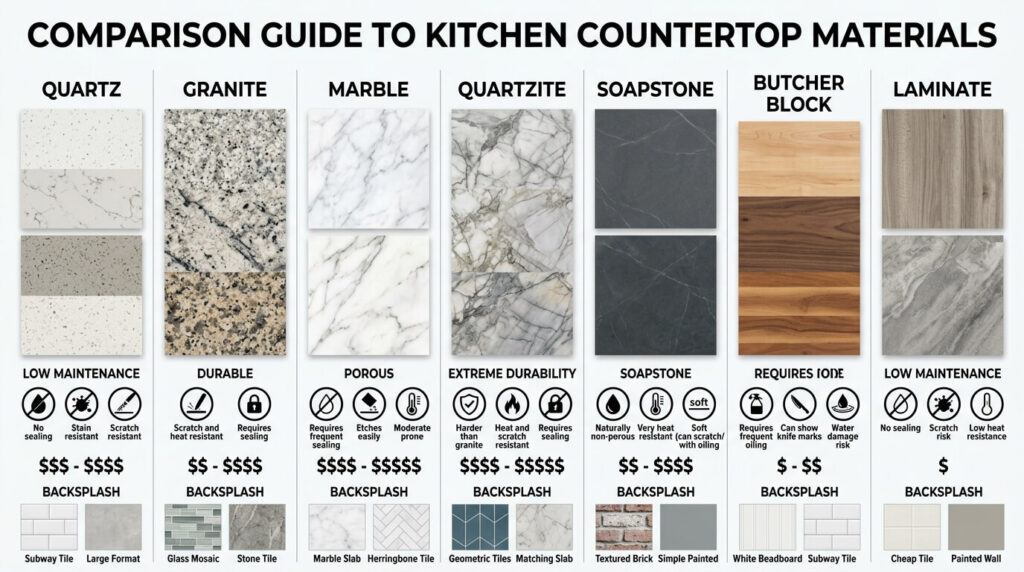
| Material | Best Paired With | Price Range* | Maintenance |
|---|---|---|---|
| Quartz (engineered) | Subway tile, hexagon, patterned porcelain | $60–$120/sq ft installed | Low — nonporous, no sealing |
| Granite | Mosaic tile, stone backsplash | $50–$100/sq ft installed | Medium — reseal yearly |
| Marble | Herringbone, subway, slab-match | $75–$250/sq ft installed | High — etches and stains easily |
| Quartzite | Zellige, glass tile, textured ceramic | $80–$200/sq ft installed | Medium — reseal annually |
| Soapstone | Beadboard, shiplap, simple subway | $70–$120/sq ft installed | Medium — oil periodically |
| Butcher block | Whitewashed brick, concrete-look tile | $35–$70/sq ft installed | Medium — oil and reseal |
| Laminate | Simple ceramic subway, painted backsplash | $20–$50/sq ft installed | Low — but not heat-resistant |
*Prices are rough national averages and vary by region, edge profile, and slab quality — always get a local quote.
8 Kitchen Counter and Backsplash Combinations That Work Every Time
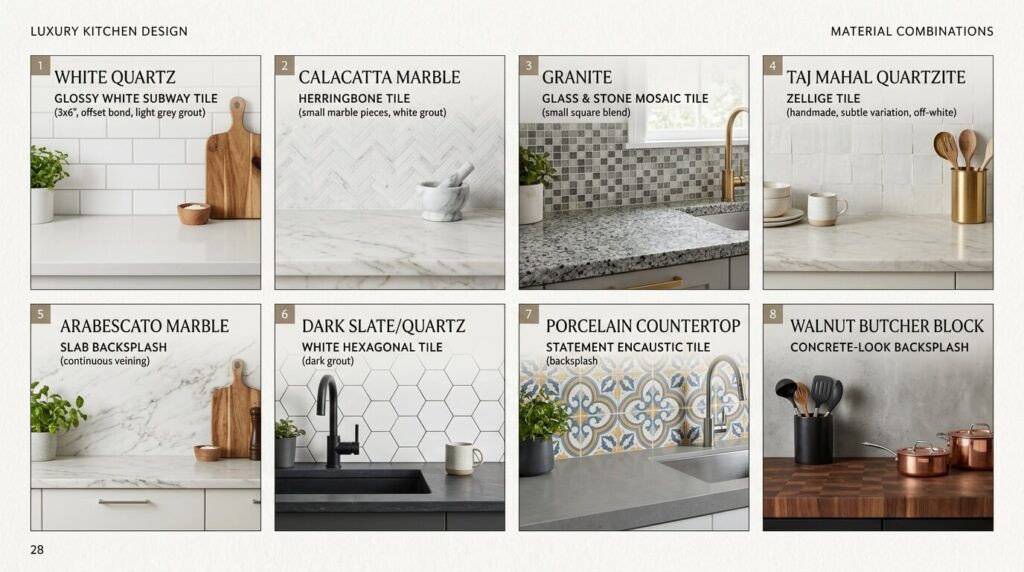
1. White Quartz Countertop + Classic Subway Tile Backsplash
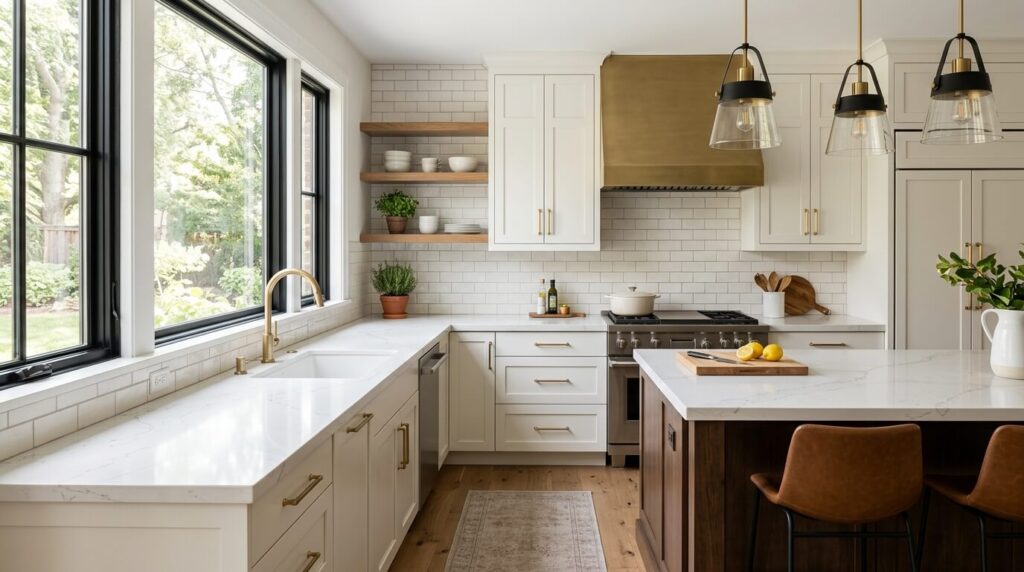
The safest, most resale-friendly pairing that exists. A clean “Super White”-style quartz counter with a white or off-white 3×6 subway backsplash never fights the rest of the room, which is exactly why designers keep coming back to it for clients who want longevity over trend-chasing.
Upgrade it: swap the grout to a soft charcoal or use a herringbone layout instead of a straight brick pattern for more movement without more color. What you know about bamboo kitchen floor.
2. Veined Marble or Marble-Look Countertop + Herringbone Backsplash
Marble’s natural movement is the star, so the backsplash needs a job that’s texture, not color. A herringbone layout in white porcelain or matching marble adds visual rhythm while staying tonally quiet enough not to compete with the veining.
3. Granite Countertop + Mosaic Tile Backsplash
Granite’s natural flecking and color variation is easy to echo rather than hide. A glass, stone, or ceramic mosaic in a coordinating shade pulls color out of the granite itself, which reads as intentional rather than matchy.
4. Quartzite Countertop + Zellige Tile Backsplash
This is the pairing designers reach for when a client wants texture without pattern. Quartzite brings subtle organic movement in the stone; handmade zellige tile stays visually calm but adds dimension through its slight color variation and characteristic uneven surface. Neither one shouts, which is exactly the point — the contrast lives in texture, not color.
5. Slab-to-Slab: Countertop Material Run Up the Wall
Running the same stone or quartz from the counter straight up the wall as a full-height backsplash eliminates the pairing question entirely. It’s a high-end look (and a higher-end price tag — expect to pay for extra slab material and precision seaming) but it delivers the most seamless, expansive feel of any option, and it makes small kitchens feel larger because the eye reads it as one continuous surface rather than two.
6. Dark Countertop + White Subway Tile (High Contrast)
Dark granite, soapstone, or a matte black quartz paired with crisp white subway tile is a classic contrast combo that photographs well and hides daily grime better than an all-white kitchen. Grout dark on the white tile ties it back to the counter color without making the backsplash feel heavy.
7. Neutral Porcelain Countertop + Counter-to-Ceiling Statement Tile
If you want a genuinely bold backsplash — a graphic pattern, a floral print, or a saturated color — keep the countertop as neutral porcelain or quartz and let the tile run from counter to ceiling instead of stopping at 18 inches. Extending the tile height turns a small design gesture into a full statement wall, and the quiet countertop keeps the whole look from becoming visually exhausting.
8. Butcher Block Countertop + Whitewashed Brick or Concrete-Look Backsplash
For farmhouse and rustic-modern kitchens, warm wood counters paired with a textured, pale backsplash (whitewashed brick, limewash-look tile, or concrete-effect porcelain) keeps everything in the same earthy, matte family. It’s one of the more forgiving pairings for a DIY renovation because neither surface is fussy about precision seams.
Should the Countertop or Backsplash Come First?
Most kitchen and bath pros recommend installing the countertop before the backsplash. It minimizes the risk of chipping finished tile during counter installation, and it lets the backsplash tile be scribed and fit tightly against the actual counter edge instead of guessing at tolerances. Selecting the material first, though, generally goes the other direction: choose the countertop — especially if it has strong veining — before you shop tile, since it sets the palette for everything else.
Tile Shapes and Formats Worth Knowing
Competitor roundups tend to treat tile shape as decoration. It’s actually a design tool:
- Large-format tile (18″+ per side) mimics a slab look at a lower cost and creates fewer grout lines, which makes a small kitchen feel bigger.
- Small mosaics and hex tile do the opposite of what you’d expect — the repetition of tiny pieces draws the eye across the wall and can widen a narrow space visually, similar to the effect of large-format tile but through texture instead of scale.
- Herringbone and chevron add movement to an otherwise plain material like white subway tile without introducing new color.
- Diamond-set or picture-frame layouts work well as a focal point behind a range, especially in kitchens where cabinets already cover most of the counter-to-ceiling wall space.
Grout: The Detail Most Guides Skip
Grout color changes a backsplash more than people expect. White grout on a brick-lay tile emphasizes the pattern and reads crisp and classic. Matching the grout to the tile color minimizes the grid entirely, which is the move if you want the material (not the layout) to be the focal point. Contrasting dark grout on light tile — a current favorite — adds definition and, practically speaking, hides daily splatter better than bright white grout does.
Small Kitchen Adjustments
- Favor large-format tile or a slab backsplash over small mosaics if the goal is to make the room feel bigger — fewer grout lines read as more square footage.
- Keep the countertop light if natural light is limited; dark stone in a small, dim kitchen can feel like it’s shrinking the walls.
- Glass tile’s reflective surface is a genuinely useful trick for a small or north-facing kitchen — it bounces available light rather than absorbing it.
Budget-Friendly Ways to Get the High-End Look
- Choose porcelain slab or large-format porcelain instead of natural stone for a marble or stone look at roughly a third of the cost.
- Tile only behind the range or sink as a focal “statement” area, and use simple subway tile elsewhere — this was one of the more practical ideas in professional kitchen tours, since it delivers the wow factor without tiling the whole wall.
- Skip the counter-to-ceiling slab and use a standard-height backsplash with a picture-frame tile insert for a similar focal effect at a fraction of the material cost.
Frequently Asked Questions
Do the countertop and backsplash need to match?
No. Matching creates a seamless, calm look, but plenty of well-designed kitchens intentionally contrast the two — a dark counter with a light backsplash, or a patterned backsplash with a solid counter. What matters more than matching is balance: one surface should lead and the other should support.
Should I pick my countertop or backsplash first?
Pick the countertop first if you’re starting from scratch, especially if you want a stone with visible veining or movement — it covers more surface area and is harder to change later, so it should set the palette. If you’re only replacing one surface and keeping the other, let the existing material be your anchor.
What’s the most timeless countertop and backsplash combination?
White or light quartz with a classic white subway tile backsplash is the pairing designers return to most often for resale value and longevity, largely because it doesn’t lock the kitchen into a specific design era.
Is it okay to run the same material from the counter up the wall?
Yes — a full-height slab backsplash in the same stone or quartz as the counter is one of the most requested high-end looks right now. It costs more in material and fabrication but eliminates any pairing risk and makes the kitchen feel more expansive.
What backsplash hides splatters and fingerprints best?
Textured or patterned tile, medium-toned grout, and matte (rather than high-gloss) finishes all hide daily grime better than glossy white subway tile with white grout, which shows every splash and needs frequent wiping.
How much should I budget for a new countertop and backsplash together?
For a standard kitchen, expect roughly $3,000–$8,000 for a mid-range quartz or granite countertop and $800–$2,500 for a tile backsplash, depending on square footage, material, and labor rates in your area. Natural stone, slab backsplashes, and handmade tile push costs higher on both ends.
Bringing It Together
The kitchens that look effortless almost never happen by accident. They come from picking one surface to lead, choosing the second to support it, and testing both together — in your actual kitchen lighting — before anything gets installed.
Start with the material you’re least willing to compromise on, whether that’s a specific stone slab or a tile pattern you can’t stop thinking about, and build the rest of the pairing around it. If you’re still deciding, order physical samples of both your top countertop and backsplash choices and hold them together, vertically and horizontally, near your cabinets and under your kitchen’s actual lighting before you commit — photos and showroom lighting are notoriously unreliable for judging undertones.
If you’re ready to move from ideas to materials, browse countertop options by material, compare backsplash tile styles and pricing, or book a design consultation to get a pairing plan specific to your kitchen’s layout and light.
