
If you’re comparing bamboo flooring for your kitchen with tile, engineered hardwood, or luxury vinyl, you’ll likely encounter plenty of misconceptions about bamboo. Bamboo is technically a grass, not a wood, and that single fact explains almost everything about how it performs — and where it can go wrong — in the busiest, wettest room in your house. You can also read about kitchen counter and backsplash ideas.
This guide pulls together what flooring retailers, fitters, and kitchen remodelers each tend to cover separately: hardness and durability numbers, moisture behavior, the cabinet installation rule almost nobody explains clearly, cost breakdowns by construction type, and the maintenance routine that actually keeps a bamboo kitchen floor looking good for 20+ years.
What Makes Bamboo Different From Hardwood Flooring
Manufacturers shred or slice bamboo stalks into strips, then bond them under heat and pressure with resin adhesives to create flooring planks. Unlike solid timber, bamboo gains its durability from the density of the compressed material rather than the natural grain of a tree.
That construction process is also why bamboo matures in three to five years versus 20+ years for hardwood species like oak or maple, and why the roots keep growing after harvest, making it one of the more renewable flooring materials on the market.
The Three Main Construction Types
- Horizontal bamboo — strips laid flat and glued face-to-face; shows the natural nodes, softer of the three types.
- Vertical bamboo — strips stood on edge and glued; slightly harder than horizontal, still relatively soft.
- Strand-woven bamboo — fibers shredded, compressed under extreme pressure, and bonded into dense planks; this is the type kitchen designers recommend almost universally.
Strand-woven bamboo consistently ranks above red oak, white oak, and hard maple on the Janka hardness scale, which measures a material’s resistance to denting and wear — a big reason it holds up under dropped cast iron pans and dragged bar stools.

Is Bamboo Flooring Actually Good for a Kitchen?
Yes, with conditions. Bamboo works well in kitchens when you choose strand-woven construction, use a quality sealed or pre-finished product, and manage spills promptly. It’s a poor fit if you’re prone to letting water sit on the floor or if your subfloor has moisture problems.
Advantages of Bamboo Flooring in the Kitchen
1. Hardness that holds up to daily kitchen abuse Strand-woven bamboo resists dents from dropped cookware and scratches from pet nails better than most traditional hardwoods, which matters in a room where something is always being carried, chopped, or set down.
2. Renewable and lower-impact sourcing Because bamboo regenerates from the same root system after harvest, it has a much shorter regrowth cycle than hardwood forests, appealing to homeowners prioritizing sustainable building materials.
3. Simple, low-maintenance cleaning routine Regular sweeping or vacuuming plus occasional damp mopping with a pH-neutral, non-wax cleaner is all a sealed bamboo floor needs to stay presentable — no refinishing schedule like solid hardwood requires.
4. Natural pest resistance In its raw, compressed state, bamboo isn’t an attractive food source for termites or wood-boring insects, lowering (though not eliminating) pest-related flooring failures.
5. Competitive price point for the performance Bamboo typically lands in the $2–$7 per square foot range depending on construction type, thickness, and finish — often cheaper than solid hardwood while offering comparable or better hardness.
6. Warm, natural aesthetic with color flexibility Natural, carbonized, and stained finishes let you match a mid-century, farmhouse, or modern kitchen without sacrificing the texture that comes with a real (not laminate) material.
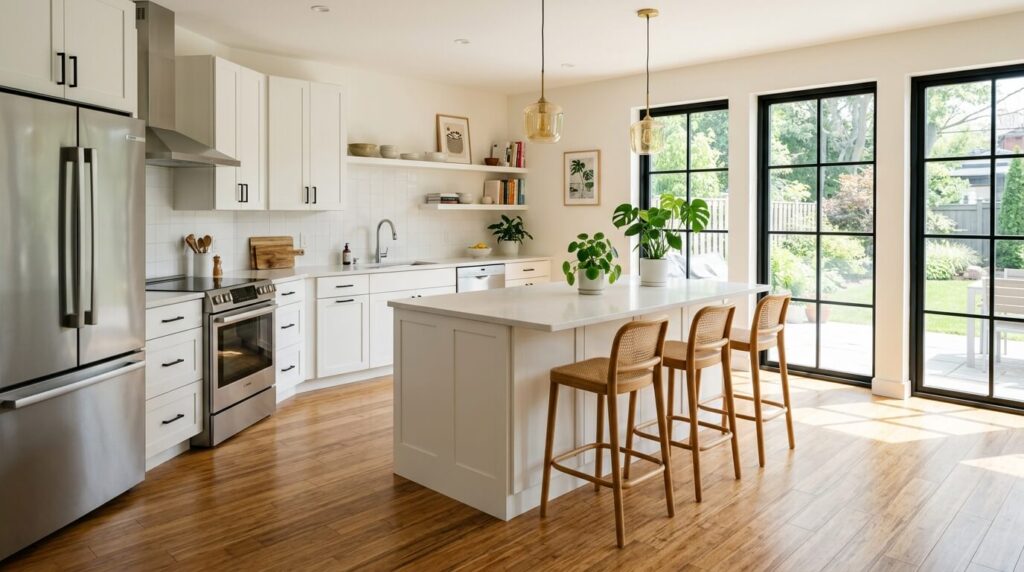
Disadvantages and Risks to Understand First
1. It is water-resistant, not waterproof Standing water left for extended periods — generally cited around 20 hours or more — can cause swelling, staining, or warping at seams, even on sealed products. Sinks, dishwashers, and refrigerator water lines are the highest-risk zones.
2. Quality varies enormously between brands Lower-grade bamboo can off-gas volatile organic compounds (VOCs) from the resin adhesives used in manufacturing. Look specifically for CARB Phase 2 compliance or equivalent low-VOC certification before purchasing.
3. Horizontal and vertical bamboo scratch more easily If a supplier doesn’t specify “strand-woven” on the label, assume you’re getting a softer product more prone to scuffing under kitchen chair legs and foot traffic.
4. Expansion and contraction require planning around cabinets This is the detail most buying guides skip entirely — see the section below, because it can make or break your installation.
5. Refinishing is more limited than solid hardwood Engineered bamboo typically has a thinner wear layer than solid hardwood, so it can usually only be sanded and refinished once or twice, versus multiple times for thick solid hardwood.

Can You Install Bamboo Flooring Under Kitchen Cabinets?
This is the single most common — and most consequential — question kitchen remodelers get, and it’s worth being direct about: you should not install floating or click-lock bamboo flooring underneath fixed kitchen cabinets or heavy islands.
Bamboo planks need room to expand and contract with seasonal humidity changes. When permanently fixed cabinetry traps and compresses the floor, the planks can’t expand and contract freely. This restriction often causes buckling, cupping, or plank separation, and the damage goes beyond appearance—it can require replacing the entire floor.
The Correct Installation Sequence
- Install kitchen cabinets and base units first, directly on the subfloor.
- Confirm the subfloor is clean, level, and fully dry before laying anything — moisture trapped under the floor is the top cause of long-term bamboo failure.
- Fit bamboo flooring around the cabinet footprint, leaving the manufacturer-recommended expansion gap (commonly ¼–½ inch) at the perimeter.
- Cover expansion gaps with kickboards, quarter-round trim, or matching bamboo transition strips so the gap is invisible once cabinets are in place.
- If you’re remodeling around existing cabinets rather than replacing them, glue-down or nail-down bamboo (rather than floating floors) is generally the safer method, since it’s less dependent on room-wide movement.
Talk to your installer about whether your specific product is rated as floating, glue-down, or nail-down — each has different expansion tolerances, and this decision should happen before cabinets go in, not after.
Bamboo Flooring and Kitchen Islands
Kitchen islands require separate consideration because installers often add them after the flooring, unlike wall cabinets. If your island is permanently fixed to the subfloor, install the bamboo flooring around it rather than underneath it. If the island simply rests on the finished floor without being bolted down, you have more flexibility. However, a heavy island can still limit a floating floor’s natural movement, making glue-down bamboo the more reliable choice in that situation.
Choosing the Right Bamboo Flooring Thickness, Width, and Finish
Retailers typically break bamboo flooring products down along a few key specs, and matching these to your kitchen’s conditions matters more than picking a color first.
- Thickness: Common options run from 3/8 in. to 1/2 in. and up to 5/8 in. Thicker planks generally handle subfloor imperfections and heavy furniture loads better.
- Plank width: Narrow (under 5 in.), medium (5.1–6.9 in.), and wide (7 in.+) planks are all available; wider planks show more of bamboo’s natural grain pattern but can be less forgiving of humidity swings.
- Water protection rating: Products are typically labeled as no water protection, water-resistant, or waterproof — waterproof engineered bamboo with a rigid core is the strongest choice directly around sinks and dishwashers.
- Installation method: Floating (click-lock), glue-down, and nail-down are the three standard methods; glue-down tends to perform best in kitchens because it restricts moisture migration under the planks.
- Manufacturers offer bamboo flooring in natural, carbonized, and stained finishes. Carbonized bamboo develops a richer, darker color through heat treatment, but the process slightly reduces its hardness compared to natural bamboo.
Bamboo Flooring vs. Other Kitchen Flooring Materials
| Material | Hardness | Water Tolerance | Typical Cost/sq ft | Refinishable |
|---|---|---|---|---|
| Strand-woven bamboo | Very high | Water-resistant only | $2–$7 | 1–2 times |
| Solid hardwood (oak) | Moderate | Low | $4–$10 | 3–5 times |
| Engineered vinyl plank | N/A (dent-resistant) | Fully waterproof | $2–$6 | Not refinishable |
| Porcelain tile | Very high | Fully waterproof | $3–$10+ | Not applicable |
Bamboo sits in a middle ground: harder than most hardwood, warmer underfoot than tile, but less forgiving of standing water than vinyl or tile. If your kitchen floods regularly or sits next to an exterior door with weather exposure, waterproof vinyl or tile may be the more practical long-term choice.
Maintaining Bamboo Flooring in a High-Moisture Room
- Wipe up all spills immediately, not just water — oil, wine, and acidic liquids can stain unsealed seams faster than plain water.
- Use felt pads under every chair and stool leg; grit trapped under furniture is the leading cause of surface scratching.
- Mop with a well-wrung, barely damp mop and a pH-neutral, non-wax cleaner — never a steam mop, which forces moisture directly into seams.
- Maintain indoor humidity between roughly 35–55% year-round; a kitchen exhaust fan that actually vents outside (not just recirculates) helps control the steam from cooking.
- Place a washable mat in front of the sink and stove — the two zones where water and grease exposure are highest.
- Re-coat or refinish the surface sealant every few years per manufacturer guidance, rather than waiting until scratches are visible.
FAQ
Is bamboo flooring waterproof enough for a kitchen?
No — bamboo is water-resistant, not waterproof. Sealed, strand-woven bamboo can handle occasional splashes and quick spills, but standing water for many hours can cause swelling or staining, so it’s not recommended directly inside high-splash zones like under a sink without extra protection.
Does bamboo flooring scratch easily in a kitchen?
Strand-woven bamboo resists scratching better than horizontal or vertical bamboo and many traditional hardwoods, but no wood-like surface is scratch-proof. Felt furniture pads and regular sweeping to remove grit are the main defenses.
Can I put bamboo flooring under a refrigerator or dishwasher?
It’s generally not recommended without extra precautions, since these appliances are common sources of slow leaks. If bamboo is installed in that zone, use a waterproof-rated product and check periodically for hidden moisture behind and beneath the appliance.
How long does bamboo flooring last in a kitchen?
Well-maintained strand-woven bamboo typically lasts 20 to 25 years or longer with proper care, though this depends heavily on product quality, moisture management, and foot traffic.
Is bamboo flooring cheaper than hardwood for a kitchen remodel?
Generally yes. Bamboo typically runs $2–$7 per square foot compared to $4–$10+ for solid hardwood, while offering comparable or superior hardness in strand-woven form, though pricing varies by brand, thickness, and finish.
Do I need special underlayment for bamboo flooring in a kitchen?
Most floating bamboo installations require a moisture barrier underlayment over the subfloor, especially on concrete slabs, to block ground moisture from reaching the planks from below. Glue-down installations may use a different adhesive-compatible underlayment — confirm with your specific product’s installation guide.
Final Thoughts
Bamboo flooring in a kitchen can be a genuinely smart choice — it’s hard, renewable, reasonably priced, and easy to live with day to day, as long as you choose strand-woven construction, install it correctly around your cabinets rather than underneath them, and stay on top of spills. The homeowners who run into trouble are almost always the ones who skipped the CARB certification check, bought horizontal-grade bamboo thinking all bamboo performs the same, or let water sit too long near the sink.
If you’re ready to move forward, get samples from at least two suppliers, confirm the water-protection rating and CARB compliance in writing, and talk to your installer about expansion clearances before your cabinets go in — not after.