
Blue is the most versatile “neutral with personality” you can put in a kitchen. It reads calm in a powder shade, dramatic in navy, coastal in aqua, and luxurious in cobalt — and unlike most accent colors, it pairs effortlessly with white, wood, black, brass, and stainless steel. That’s exactly why blue backsplash kitchen ideas are one of the most-searched kitchen design topics year after year.
This guide goes further than a simple photo roundup. You’ll find every shade and material option, the patterns and layouts designers actually use, how to pair a blue backsplash with cabinets and countertops, what it really costs to install in 2026, maintenance realities, common mistakes, and answers to the questions people ask most before committing to this look.
What Is a Blue Backsplash, Exactly?
A backsplash is the protective and decorative surface installed on the wall between your countertop and upper cabinets (or extending to the ceiling in some designs). Its job is functional first — shielding drywall from grease, water, and food splatter behind the sink, range, and prep areas — and decorative second.
A blue backsplash simply uses blue-toned tile, glass, stone, or panel material instead of the more common white or neutral options. Because blue spans such a wide range of hues — from icy pastels to near-black navy — it functions almost like a neutral itself while still injecting color and depth into a kitchen.
Why Blue Works So Well in a Kitchen
- Psychologically calming. Blue is associated with calm, cleanliness, and focus, which is part of why it’s a popular choice for a room centered on food prep.
- Pairs with almost any cabinet color. White, cream, navy, sage, black, and natural wood cabinetry all read well against blue tile.
- Wide tonal range. You can go subtle (powder blue, dusty blue-gray) or bold (cobalt, navy, indigo) without changing materials — just the glaze.
- Timeless, not trendy. Unlike some color trends that age quickly, blue-and-white kitchens have remained a design constant for decades, especially in coastal, farmhouse, and traditional styles.
- Hides minor splatter and water spots better than stark white in some finishes, particularly matte and textured glazes.

Shades of Blue to Consider
| Shade | Visual Effect | Best Paired With |
|---|---|---|
| Navy / Indigo | Bold, dramatic, sophisticated | White or cream cabinets, brass or gold hardware |
| Cobalt | Vibrant, saturated, statement-making | White marble countertops, black accents |
| Cerulean / Sky Blue | Fresh, bright, energetic | Light wood cabinets, white trim |
| Teal / Peacock | Jewel-toned, moody, eclectic | Black or charcoal cabinets, warm wood floors |
| Turquoise / Aqua | Playful, coastal, retro | White shaker cabinets, chrome fixtures |
| Slate Blue / Blue-Gray | Subtle, modern, transitional | Gray or greige cabinetry, matte black fixtures |
| Powder / Baby Blue | Soft, vintage, romantic | White or cream cabinets, brushed nickel |
| Denim Blue | Casual, farmhouse, lived-in | Butcher block counters, open shelving |
Materials for a Blue Backsplash
Choosing a material is just as important as choosing a shade — it affects durability, maintenance, light reflection, and cost.
Ceramic Tile
The most popular and budget-friendly option. Glazed ceramic resists stains and is easy to wipe down. Available in nearly unlimited blue glazes, from matte slate to glossy cobalt. Best for most homeowners who want classic style without a high price tag.
Porcelain Tile
Denser and more water-resistant than ceramic, with similar visual flexibility. A good upgrade pick if your backsplash will see heavy splatter near a range.
Glass Tile
Reflective and luminous — glass tile bounces light around the room, which is part of why it’s favored in smaller or darker kitchens. It’s nonporous (no sealing needed) but shows water spots more visibly than matte ceramic, so it needs more frequent wiping for a pristine look.
Mosaic Tile
Small-format tile (often 1–2 inches) mounted on mesh sheets, used for intricate patterns, gradients, or accent strips. Mosaic offers the most color and texture variation but typically costs more in labor due to the higher number of grout lines.
Handpainted / Artisan Tile
Custom motifs, Moroccan-inspired patterns, and one-of-a-kind colorways. This is the premium tier — gorgeous as a focal point but priced accordingly, and usually reserved for a single accent wall or range hood area rather than a full backsplash.
Natural Stone (Marble, Quartzite)
Blue-veined marble (like certain Azul or Bahia varieties) or blue-gray quartzite creates a luxurious, organic look with continuous veining instead of grout lines. It requires periodic sealing and is the most expensive option per square foot.

Peel-and-Stick Tile
A budget and renter-friendly option that mimics the look of real tile using adhesive vinyl or gel panels. Good for a temporary refresh, but it’s not recommended directly behind a range due to heat exposure, and it lacks the longevity of true tile.
Thin Brick Veneer
Real or faux clay brick in blue glazes adds rustic, textured charm — popular in industrial and farmhouse kitchens.
Patterns and Layouts for Blue Tile
| Pattern | Description | Visual Effect |
|---|---|---|
| Subway / Running Bond | Rectangular tiles laid in offset rows, like a brick wall | Classic, clean, timeless |
| Straight-Set / Stacked | Tiles aligned in a simple grid | Modern, minimal |
| Herringbone | Tiles set at 45° angles in a V pattern | Dynamic, upscale, eye-catching |
| Chevron | Tiles cut at an angle to form continuous zigzag points | Bold, geometric, contemporary |
| Hexagon | Six-sided tiles fitted edge to edge | Retro-modern, honeycomb texture |
| Picket | Elongated tiles set vertically in a lattice-like pattern | Timeless with a twist |
| Scalloped / Fish-Scale | Curved, overlapping tile edges | Whimsical, soft, cottage-style |
| Moroccan Mosaic | Intricate geometric or floral tile shapes | Exotic, artistic, bohemian |
| Brick / Stacked Brick | Rectangular brick-shaped tile in horizontal rows | Rustic, industrial |
| Ombre / Gradient | Tiles transition from dark to light blue | Artistic, modern statement |
Blue Backsplash Kitchen Ideas
Pairing a Blue Backsplash With the Rest of Your Kitchen
With White Cabinets
The most popular combination by far. White cabinetry lets a blue backsplash — whether subtle slate or bold navy — become the visual centerpiece of the room. This pairing works in coastal, farmhouse, traditional, and modern kitchens alike.
With Navy or Blue Cabinets
Pairing a backsplash in a different shade of blue than your cabinets (for example, navy cabinets with a lighter sky-blue tile, or vice versa) adds depth without looking matchy. Monochromatic all-blue kitchens are a growing trend for those who want maximum color commitment.
With Wood Cabinets
Warm or natural wood tones soften a blue backsplash and lean the kitchen toward midcentury modern, Scandinavian, or organic-modern styles. Walnut and white oak are especially popular pairings with slate blue or denim tile right now.
With Black or Charcoal Cabinets
Deep teal or peacock-blue tile against black cabinetry creates a moody, jewel-box effect that reads as upscale and dramatic — ideal for a statement kitchen.
Countertops
- White marble or quartz: classic contrast, lets the blue backsplash stand out
- Butcher block or wood: warms up cool blue tones for a farmhouse feel
- Black granite or soapstone: anchors the space and intensifies the blue
- Light quartz with subtle veining: keeps the room bright while letting blue act as the color statement
Grout Color
- White or light gray grout with blue tile creates contrast and emphasizes individual tile shapes — best for classic subway and hexagon layouts.
- Matching or dark blue/charcoal grout creates a more monolithic, seamless look that lets color and pattern (not grout lines) read as the feature, popular with mosaic and herringbone layouts.
Hardware and Fixtures
Gold and brass hardware add warmth and a touch of glamour against blue tile, especially navy. Brushed nickel and chrome feel fresh and coastal against lighter blues. Matte black hardware pairs well with teal, indigo, and deep cobalt for a more dramatic, contemporary look.
Blue Backsplash Ideas by Kitchen Style
- Coastal: light blue or aqua glass/ceramic tile, white shaker cabinets, natural wood accents, brushed nickel fixtures
- Farmhouse: denim-blue subway tile, butcher block counters, open shelving, apron-front sink
- Modern/Contemporary: large-format cobalt or slate glass tile in a straight-set pattern, handleless cabinetry, matte black fixtures
- Traditional: Moroccan or handpainted blue mosaic as a range-hood focal point, raised-panel white cabinetry, brass hardware
- Midcentury Modern: small diamond or hexagon tile in deep azul blue, walnut cabinets, minimalist hardware
- Mediterranean: cobalt and white patterned tile, terracotta floors, wrought-iron fixtures
- Eclectic/Maximalist: mixed blue shades, scalloped or picket tile, two-tone cabinetry, bold pendant lighting
- Industrial: thin brick veneer in turquoise or slate blue, exposed shelving, black steel accents
Pros and Cons of a Blue Backsplash
Pros
- Extremely versatile across design styles
- Wide range of price points — budget ceramic to luxury hand-painted tile
- Easy to clean (most glazed tile options)
- Timeless rather than trend-dependent
- Pairs with nearly any cabinet, countertop, or hardware finish
Cons
- Darker shades (navy, indigo) can make a small or low-light kitchen feel more enclosed if used floor-to-ceiling
- Glossy glass tile shows water spots and fingerprints more readily than matte ceramic
- Natural stone in blue tones requires sealing and ongoing maintenance
- Highly patterned or handpainted tile can be costly and harder to source for future repairs
- Bold colors are a bigger commitment if you plan to sell soon — neutral buyers may prefer it muted

How Much Does a Blue Backsplash Cost in 2026?
Backsplash pricing depends on material, pattern complexity, square footage, and labor rates in your area. Here’s a realistic breakdown for a typical 25–35 square foot kitchen backsplash:
| Material | Material Cost (per sq ft) | Installed Cost (per sq ft) | Typical Total Project Cost |
|---|---|---|---|
| Ceramic tile | $1–$8 | $12–$28 | $500–$1,100 |
| Porcelain tile | $2–$10 | $14–$30 | $550–$1,200 |
| Glass tile | $10–$30 | $25–$40 | $900–$1,600 |
| Mosaic tile | $8–$25 | $20–$43 | $700–$1,700 |
| Handpainted/artisan tile | $20–$50+ | $35–$60+ | $1,200–$3,000+ |
| Natural stone (marble/quartzite) | $15–$60+ | $35–$200 | $1,500–$4,500+ |
| Peel-and-stick | $2–$15 | DIY (no labor) | $100–$500 |
| Thin brick veneer | $4–$13 | $15–$30 | $600–$1,300 |
Cost factors that move the price:
- Pattern complexity: Herringbone and chevron layouts can add 15–25% to labor costs over a simple stacked or subway pattern due to extra cuts and alignment time.
- Removal of an old backsplash: Adds roughly $2–$6 per square foot, plus possible drywall repair.
- Number of outlets, windows, and corners: Each obstacle requires custom cuts, adding time and cost.
- Grout and sealant: Typically $1–$2 per square foot extra.
- Region and labor demand: Metro areas and busy renovation seasons (spring/summer) tend to push labor rates toward the higher end of national ranges.
A good rule of thumb: budget an extra 10–15% in tile quantity to cover cuts, breakage, and future repairs of the exact same dye lot.
Installation Process and Timeline
- Design and material selection – choose tile, pattern, and grout color; order samples if possible to check color under your kitchen’s actual lighting.
- Surface prep – walls are cleaned, and any old backsplash is removed; drywall or backer board repairs are made if needed.
- Layout planning – the installer dry-lays or marks the pattern to center it visually and minimize awkward cuts at corners and outlets.
- Tile setting – tiles are set with thinset mortar (or adhesive for peel-and-stick) and spaced with tile spacers.
- Curing – thinset typically needs 24 hours to cure before grouting.
- Grouting and sealing – grout is applied, cleaned off the tile face, and allowed to cure; grout and certain stone tiles are then sealed.
- Caulking – a flexible caulk line (not grout) is applied where the backsplash meets the countertop to allow for movement and prevent water intrusion.
For a standard-size kitchen, expect 2–4 days total from prep to finished, sealed backsplash, including dry time between steps. A simple, small backsplash with straightforward access can sometimes be completed in a single day.
Maintenance and Cleaning
- Daily/weekly: wipe glazed tile with a soft cloth and mild dish soap and water; avoid abrasive scrubbers on glass or matte finishes.
- Grout care: seal grout lines annually (more often in high-splatter zones behind the range) to resist staining and moisture.
- Natural stone: reseal every 6–12 months depending on the stone type and how porous it is.
- Hard water spots on glass tile: a vinegar-water solution or a dedicated glass cleaner removes mineral buildup without scratching.
- Avoid: bleach-based cleaners on colored grout (can lighten or discolor it) and steel wool on glazed or glass tile (can scratch the surface).
Common Mistakes to Avoid
- Choosing tile color without testing it in your kitchen’s actual lighting. Blue can shift dramatically between warm incandescent and cool LED light.
- Going floor-to-ceiling with a very dark navy in a small, low-light kitchen without balancing it with lighter cabinets, countertops, or lighting.
- Mismatching grout and tile undertones — cool-toned blue tile with warm beige grout can look muddy.
- Skipping samples. Always order at least one full tile sample, not just a digital swatch, since glazes vary in person.
- Overlooking maintenance needs of the material — falling in love with natural stone without budgeting for ongoing sealing.
- Ignoring resale considerations if you plan to sell within a couple of years; very bold, saturated color can narrow your buyer pool slightly more than a neutral choice.
- Underestimating tile quantity and not ordering extra for waste, cuts, or future repairs.
Expert Tips for Choosing the Right Blue
- Pull a sample tile and place it against your cabinet door and countertop sample in your kitchen at different times of day before finalizing.
- If your kitchen gets mostly north-facing or indirect light, cooler blues can read as gray or even slightly green — warmer blue undertones often look truer in low-light spaces.
- Use a bolder blue as a focal-point accent (behind the range or stove) and a calmer, lighter tile for the rest of the wall if you want color without overwhelming a small kitchen.
- Keep at least one large neutral surface (countertop, cabinets, or floor) to let a saturated blue backsplash breathe rather than competing with multiple bold elements.
Comparison: Best Blue Backsplash Material by Priority
| If Your Priority Is… | Best Material Choice |
|---|---|
| Lowest cost | Ceramic tile or peel-and-stick |
| Easiest maintenance | Glazed ceramic or porcelain |
| Maximum brightness/light reflection | Glass tile |
| Most unique, artistic look | Handpainted or mosaic tile |
| Most luxurious, high-end finish | Natural stone (marble, quartzite) |
| DIY installation | Peel-and-stick or large-format ceramic |
| Best durability behind a range | Porcelain or glazed ceramic |

Frequently Asked Questions
Does a blue backsplash go out of style?
Blue, especially paired with white, has remained a steady choice in kitchen design for decades rather than spiking and crashing like some trend colors. Choosing a classic pattern (subway, hexagon) in a versatile shade (slate blue, navy) tends to age the best.
What color cabinets go best with a blue backsplash?
White and cream cabinets are the most universally flattering pairing. Wood tones add warmth, black or charcoal adds drama, and a different shade of blue creates a cohesive monochromatic look.
Is a dark blue backsplash a bad idea in a small kitchen?
Not necessarily, but it’s worth balancing dark tile with ample lighting and at least one light-colored surface (cabinets, countertop) so the space doesn’t feel closed in. Using dark blue as a partial accent rather than full wall-to-ceiling coverage is a common workaround.
What’s the cheapest way to get a blue backsplash?
Peel-and-stick blue tile panels or basic glazed ceramic subway tile in a simple straight-set or running-bond pattern are the most budget-friendly routes.
Can I install a blue tile backsplash myself?
Simple, small-format ceramic or peel-and-stick tile in a straightforward layout is doable for a confident DIYer. Intricate patterns (herringbone, mosaic), natural stone, and large-format glass tile are best left to a professional due to cutting precision and the risk of costly mistakes.
Does blue tile need to be sealed?
Most glazed ceramic, porcelain, and glass tile does not need sealing. Natural stone (marble, quartzite) and the grout lines around any tile typically do need periodic sealing to resist staining.
What’s the difference between cobalt, navy, and slate blue for a backsplash?
Cobalt is a bright, saturated true blue; navy is a very dark, almost black-blue; slate blue leans gray and reads as more muted and transitional. Each creates a noticeably different mood even in the same tile shape.
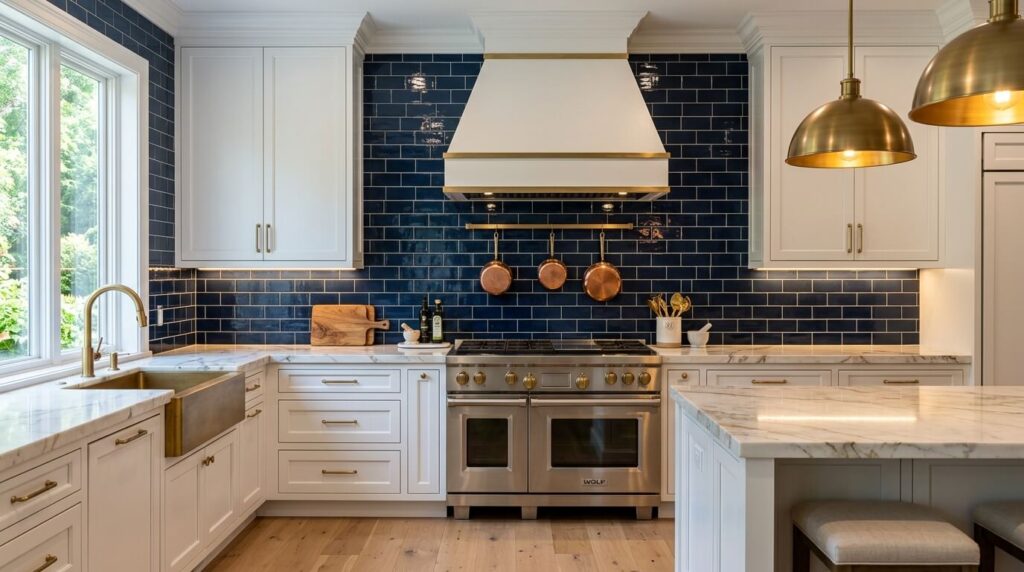
Will a blue backsplash clash with stainless steel appliances?
No — stainless steel is neutral and pairs easily with virtually any blue shade, from soft coastal hues to deep navy.
What grout color works best with blue tile?
White or light gray grout creates contrast and highlights the tile shape; matching or dark grout creates a more seamless, monolithic look. The right choice depends on whether you want the grout lines to be a visible design element or to disappear.
How long does a blue tile backsplash last?
A properly installed ceramic, porcelain, or natural stone backsplash can last 20+ years with normal maintenance. Peel-and-stick options are more of a medium-term solution, generally lasting a few years before showing wear.
Is glass tile harder to clean than ceramic?
Glass tile is nonporous and easy to wipe clean, but it shows water spots, smudges, and fingerprints more visibly than a matte ceramic glaze, so it may need more frequent light cleaning to stay looking pristine.
Can I mix two shades of blue in one backsplash?
Yes — ombre/gradient layouts, accent strips, and two-tone patterns using different blue shades are a popular way to add depth without introducing an entirely different color.
What’s trending right now in blue backsplash design?
Slate and dusty blue-gray tones in large-format straight-set layouts, deep teal paired with black cabinetry, and handpainted artisan tile as a focal accent behind the range are all seeing strong design interest currently.
Do I need a different backsplash material behind the stove?
Not necessarily a different material, but heat-resistant, easy-to-clean options like glazed ceramic, porcelain, or glass are preferable in that zone over peel-and-stick or unsealed natural stone.
How do I keep a blue backsplash from feeling too cold?
Pair it with warm-toned wood cabinetry or open shelving, brass or gold hardware, and warm white or soft ambient lighting to balance blue’s naturally cool undertone.
